This pull request introduces a new `markdown` crate which is capable of
parsing and rendering a Markdown source. One of the key additions is
that it enables text selection within a `Markdown` view. Eventually,
this will replace `RichText` but for now the goal is to use it in the
assistant revamped assistant in the spirit of making progress.

<img width="711" alt="image"
src="https://github.com/zed-industries/zed/assets/482957/b56c777b-e57c-42f9-95c1-3ada22f63a69">

Note that this pull request doesn't yet use the new markdown renderer in
`assistant2`. This is because we need to modify the assistant before
slotting in the new renderer and I wanted to merge this independently of
those changes.

Release Notes:

- N/A

---------

Co-authored-by: Nathan Sobo <nathan@zed.dev>
Co-authored-by: Conrad <conrad@zed.dev>
Co-authored-by: Alp <akeles@umd.edu>
Co-authored-by: Zachiah Sawyer <zachiah@proton.me>
This PR makes the `border` methods require an explicit width instead of
defaulting to 1px.

This breaks convention with Tailwind, but it makes GPUI more consistent
with itself. We already have an edge case where the parameterized method
had to be named `border_width`, since `border` was taken up by an alias
for the 1px variant.

### Before

```rs
div()
    .border()
    .border_t()
    .border_r()
    .border_b()
    .border_l()
    .border_width(px(7.))
```

### After

```rs
div()
    .border_1()
    .border_t_1()
    .border_r_1()
    .border_b_1()
    .border_l_1()
    .border(px(7.))
```

Release Notes:

- N/A
- Unifies spacing between left and right sides of the tab bar
- Use the default icon color for `end_slot` tools. This should help more
clearly differentiate when forward or backward navigation is disabled
due to the tools on the other side not looking so much like the disabled
navigation arrows.
- Rework the TabBar implementation in `pane.rs` to directly pass in
items to the `start_slot` instead of an unneeded extra horizontal
layout.
Left side:

Right side:
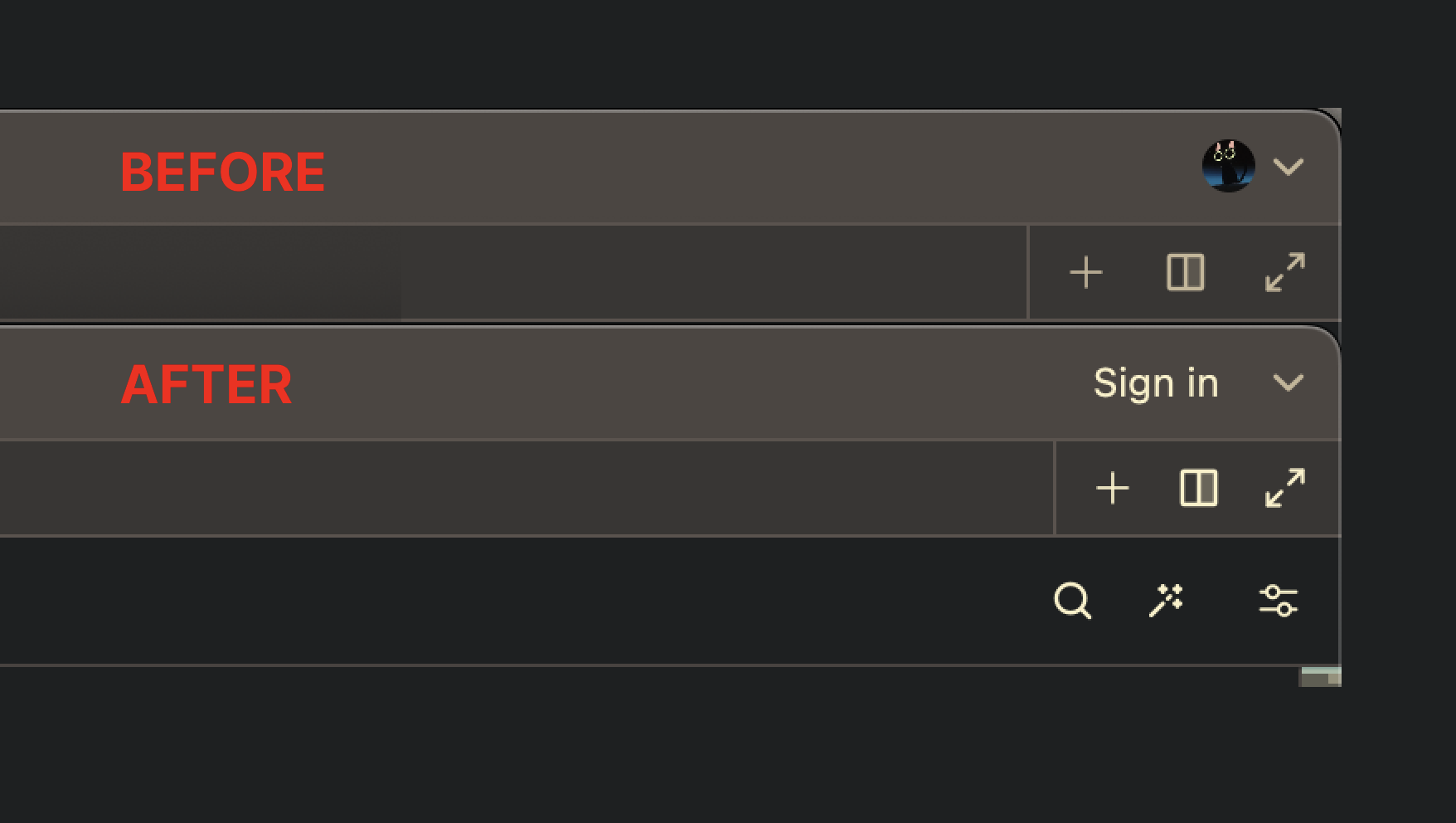
Release Notes:
- Standardized some Tab Bar UI elements. You many notice some slight
spacing or color changes.
Note: You shouldn't use the `unstable.ui_density` setting – it is only
being added for testing and to enable new UI components to be built with
density in mind. Don't expect this to work well, or at all right now.

Adds some of the basic wiring we'll need to start scaling UI elements
throughout the app based on a desired density setting.

Release Notes:

- N/A
This PR adds a new `rems_from_px` helper function that can be used to
compute rem values based on a pixel value.

This is something we do fairly commonly, where we want to express a size
that is a given pixel size at the base rem size (e.g., "14px when the
rem size is 16px").

`rems_from_px` helps make the intent more explicit, as well as prevent
the base rem size from being duplicated everywhere.

Note: Ideally we would want `rems_from_px` to be `const`, but that
depends on https://github.com/rust-lang/rust/issues/57241.

Release Notes:

- N/A
See https://zed.dev/channel/gpui-536
Fixes https://github.com/zed-industries/zed/issues/9010
Fixes https://github.com/zed-industries/zed/issues/8883
Fixes https://github.com/zed-industries/zed/issues/8640
Fixes https://github.com/zed-industries/zed/issues/8598
Fixes https://github.com/zed-industries/zed/issues/8579
Fixes https://github.com/zed-industries/zed/issues/8363
Fixes https://github.com/zed-industries/zed/issues/8207
### Problem
After transitioning Zed to GPUI 2, we started noticing that interacting
with the mouse on many UI elements would lead to a pretty annoying
flicker. The main issue with the old approach was that hover state was
calculated based on the previous frame. That is, when computing whether
a given element was hovered in the current frame, we would use
information about the same element in the previous frame.
However, inspecting the previous frame tells us very little about what
should be hovered in the current frame, as elements in the current frame
may have changed significantly.
### Solution
This pull request's main contribution is the introduction of a new
`after_layout` phase when redrawing the window. The key idea is that
we'll give every element a chance to register a hitbox (see
`ElementContext::insert_hitbox`) before painting anything. Then, during
the `paint` phase, elements can determine whether they're the topmost
and draw their hover state accordingly.
We are also removing the ability to give an arbitrary z-index to
elements. Instead, we will follow the much simpler painter's algorithm.
That is, an element that gets painted after will be drawn on top of an
element that got painted earlier. Elements can still escape their
current "stacking context" by using the new `ElementContext::defer_draw`
method (see `Overlay` for an example). Elements drawn using this method
will still be logically considered as being children of their original
parent (for keybinding, focus and cache invalidation purposes) but their
layout and paint passes will be deferred until the currently-drawn
element is done.
With these changes we also reworked geometry batching within the
`Scene`. The new approach uses an AABB tree to determine geometry
occlusion, which allows the GPU to render non-overlapping geometry in
parallel.
### Performance
Performance is slightly better than on `main` even though this new
approach is more correct and we're maintaining an extra data structure
(the AABB tree).

Release Notes:
- Fixed a bug that was causing popovers to flicker.
---------
Co-authored-by: Nathan Sobo <nathan@zed.dev>
Co-authored-by: Thorsten <thorsten@zed.dev>
This PR renames the `overflow_hidden_x` and `overflow_hidden_y` methods
to `overflow_x_hidden` and `overflow_y_hidden`, respectively.

This provides consistency with our `overflow_x_scroll` /
`overflow_y_scroll` methods, as well as better matches Tailwind's
naming.

Release Notes:

- N/A
This PR renames the `h_stack` and `v_stack` to `h_flex` and `v_flex`,
respectively.

We were previously using `h_stack` and `v_stack` to match SwiftUI, but
`h_flex` and `v_flex` fit better with the web/flexbox terminology that
the rest of GPUI uses.

Additionally, we were already calling the utility functions used to
implement `h_stack` and `v_stack` by the new names.

Release Notes:

- N/A
This PR deletes the old `ui` and `storybook` crates in favor of their
newer variants that we'll be landing to `main` in the near future.

### Motivation

These crates are based off the old version of GPUI 2 (the `gpui2`
crate).

At this point we have since transitioned to the new version of GPUI 2
(the `gpui3` crate, currently still on the `gpui2` branch).

Having both copies around is confusing, so the old ones are going the
way of the dinosaurs.

Release Notes:

- N/A
This PR restructures the `ui` crate into just `elements` and
`components`.

This was already done on the `gpui2-ui` branch, just getting it onto
`main`.

Release Notes:

- N/A

---------

Co-authored-by: Nate Butler <nate@zed.dev>


 Marshall Bowers
 Nate Butler

 Mikayla

 Thorsten BallandMarshall
 Max BrunsfeldandMikayla


