 Mike-Solar
fec6e9dba7
Mike-Solar
fec6e9dba7
docs/zh/plans/render-pipeline-threads.md M3 (design 3.2): OpenFX crash
isolation moves from "every worker hosts plugins" to a single dedicated
host process, served over NDJSON + shared memory.

- oak-worker --ofx-host mode (src/ofx_host.rs): loads every plugin once,
  resolves jobs by the cross-process-stable OFX identifier, and renders
  through the same in-process executor the workers used to install.
- oak-render/ofxhost.rs: the single-host client. The render manager
  creates and installs it for the Pipeline backend (lazy spawn on the
  first plugin job); eval::process_plugin_job prefers it and falls back
  to the in-process executor otherwise, so the process backend keeps its
  current behavior until M4.
- Data plane: input/output FrameSlotPool pairs (the handshake's input_*
  fields are used for the first time). Named clips and the source frame
  are written to input slots after the explicit CPU readback; the plugin
  output returns through an output slot. Pool size/capacity grow by a
  host restart when a job needs more (safe: submissions are serialized
  and one job is in flight).
- Crash loop: reader EOF fails the in-flight submit, which respawns the
  host and re-posts the same job (frames are read back once); after three
  consecutive crashes the client is permanently dead and the evaluator
  falls back to a purple frame. The dead child is reaped immediately, and
  a submit mutex enforces the one-job-in-flight contract.
- Progress/cancel: the host flushes plugin_progress immediately (live
  progress), and reads stdin on its own thread so plugin_cancel takes
  effect mid-render at the plugin's next progressUpdate; the sticky flag
  resets at progressStart and request_plugin_cancel_all broadcasts to
  both the worker pool and the host.
- JobSpec::Plugin / PluginJobPayload carry the plugin type_id (stable
  across processes); `--ofx-crash-once` / `--ofx-crash-always` are the
  deterministic crash hooks, matching the worker's env hooks.
- Tests: wire round-trips; host unit tests (crash budget, cancel-flag
  reset through the factory, source mapping); oak-worker integration
  tests against the real host + bundled test plugin (render + progress,
  crash respawn and re-post, three-crash give-up, mid-render cancel on
  the new slow variant, concurrent submits); eval's purple fallback.


Oak Video Editor 
Oak Video Editor is a free non-linear video editor for Windows, macOS, and Linux.
This project is a community-maintained fork of Olive Video Editor.
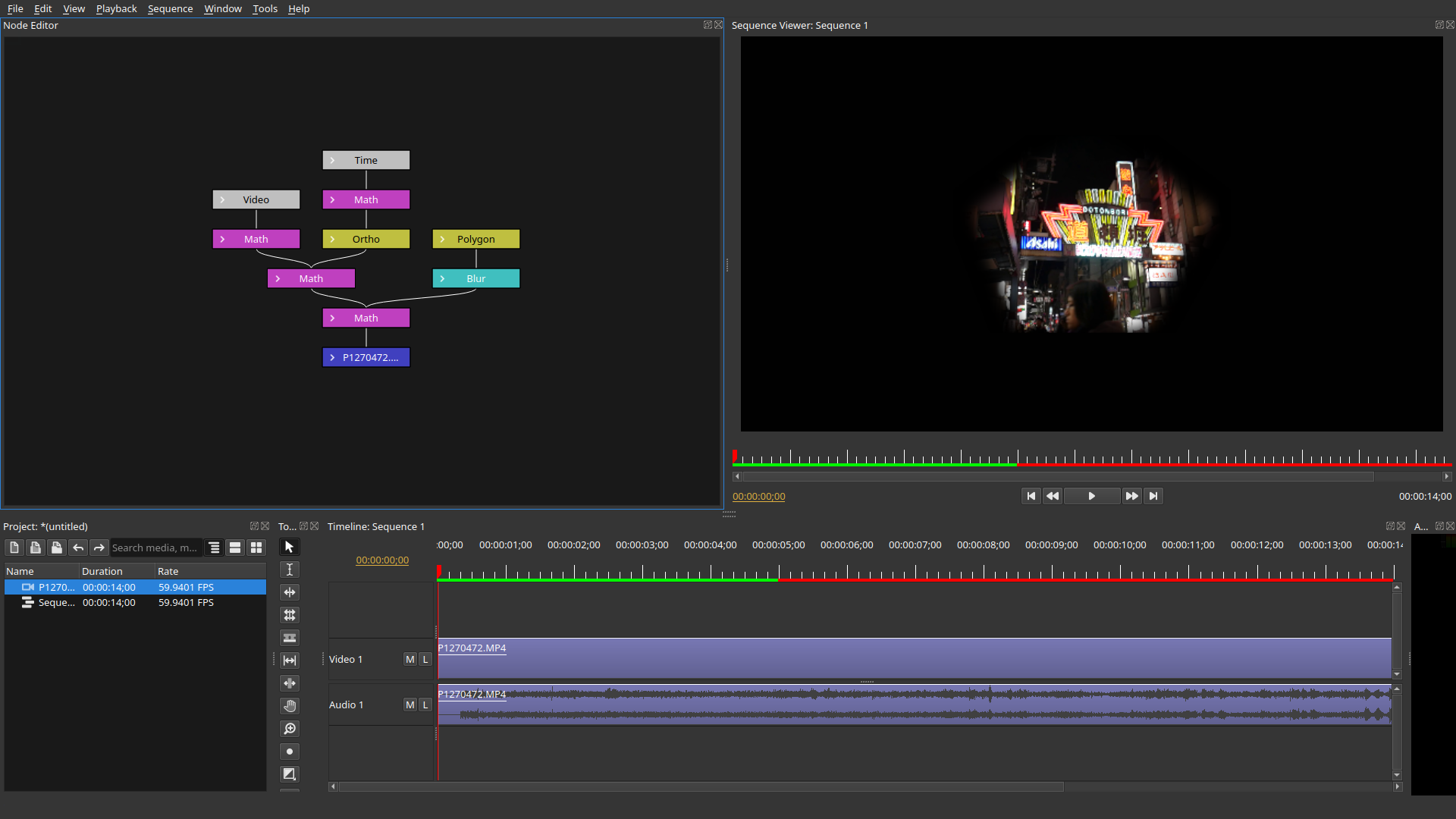
NOTE: Oak Video Editor is alpha software and is considered highly unstable. While we highly appreciate users testing and providing usage information, please use at your own risk.
Binaries
The binary can be downloaded here:
Building from Source
See docs/build.md for build instructions on Windows (MSYS2), Linux (Debian/Ubuntu, Fedora, Arch Linux), and macOS.
Documentation
- Project Storage Architecture (中文) — database write-through persistence, node-granular journal, persistent undo
- Build guide · 工程文件格式
Roadmap
| Version | Theme | Core Deliverables | Boundary Notes |
|---|---|---|---|
| 0.3 | Plugin Architecture Milestone | Production-ready OpenFX host support | Not about quantity of plugins, but "any OFX plugin loads without crashing" |
| 0.4 | Color, Audio & Performance | .cube/.3dl support, scopes (waveform/vectorscope/histogram), three-way color wheels, waveform auto-sync, BWF timecode sync, audio meters (LUFS/VU), proxy media workflow, hardware-accelerated export (NVENC/VideoToolbox), batch render queue |
Combines the previous 0.4-0.6 scope into one usability milestone: color workflow, audio sync, and 4K/8K performance |
| 0.5 | Animation, Tracking & Collaboration | Bézier keyframe curve editor, basic point tracking, image stabilizer, full multicam angle switching, OpenTimelineIO, EDL/XML import/export | Combines the previous 0.7-0.8 scope into one timeline/interchange milestone |
| 0.6 | Stability Milestone | Project file format freeze (backward compatibility promise), crash recovery, autosave, memory optimization | "Feature freeze" testing period before 1.0 |
| 1.0 | Production Ready | Complete documentation, installers, known issues list, community support channels | Declared "ready for serious projects" |