 Mike-Solar
f2aab8ce15
Mike-Solar
f2aab8ce15
Adding an effect to a clip did nothing: the sequence render is
flattened into a montage (decode + composite), and MontageClip carried
no effect data at all.

- MontageClip gains an ordered effect stack (type id / enabled /
  effect input / parameter values); protocol v2 carries it as an
  additive wire field (older peers default to an empty stack).
- renderops::video_montage fills the stack from the effect chain
  (the footage source node — the chain end without an effect input —
  is dropped; the montage decodes the footage itself). Export
  (oak-task) and the multicam single-track montage fill it too.
- The worker applies the stack between decode and composite: built-in
  Opacity gets a CPU evaluator (C++ opacity.frag parity — whole vec4,
  alpha included, unity pass-through); everything else dispatches as an
  OFX plugin job through a new instance-factory slot (oak-plugin
  lazily creates + caches one instance per identifier per render
  process) with the montage's parameters injected. Disabled effects
  bypass (the C++ traverser pushes the effect input through). Unknown
  types warn once per type id and pass through — no silent no-ops.

Not covered (explicitly): Transform/Crop and the other ~30 built-in
effects have no CPU evaluator in oak-render (they pass through with a
warning), keyframed parameter animation, audio effect chains, and the
CLI's simplified montage.

Acceptance: a real 50% Opacity on real media quarters the rendered
pixels both in-process (renderops test) and through a real worker
process over IPC + shared memory (procpool_integration test);
disabling restores the plain render byte-for-byte.


Oak Video Editor 
Oak Video Editor is a free non-linear video editor for Windows, macOS, and Linux.
This project is a community-maintained fork of Olive Video Editor.
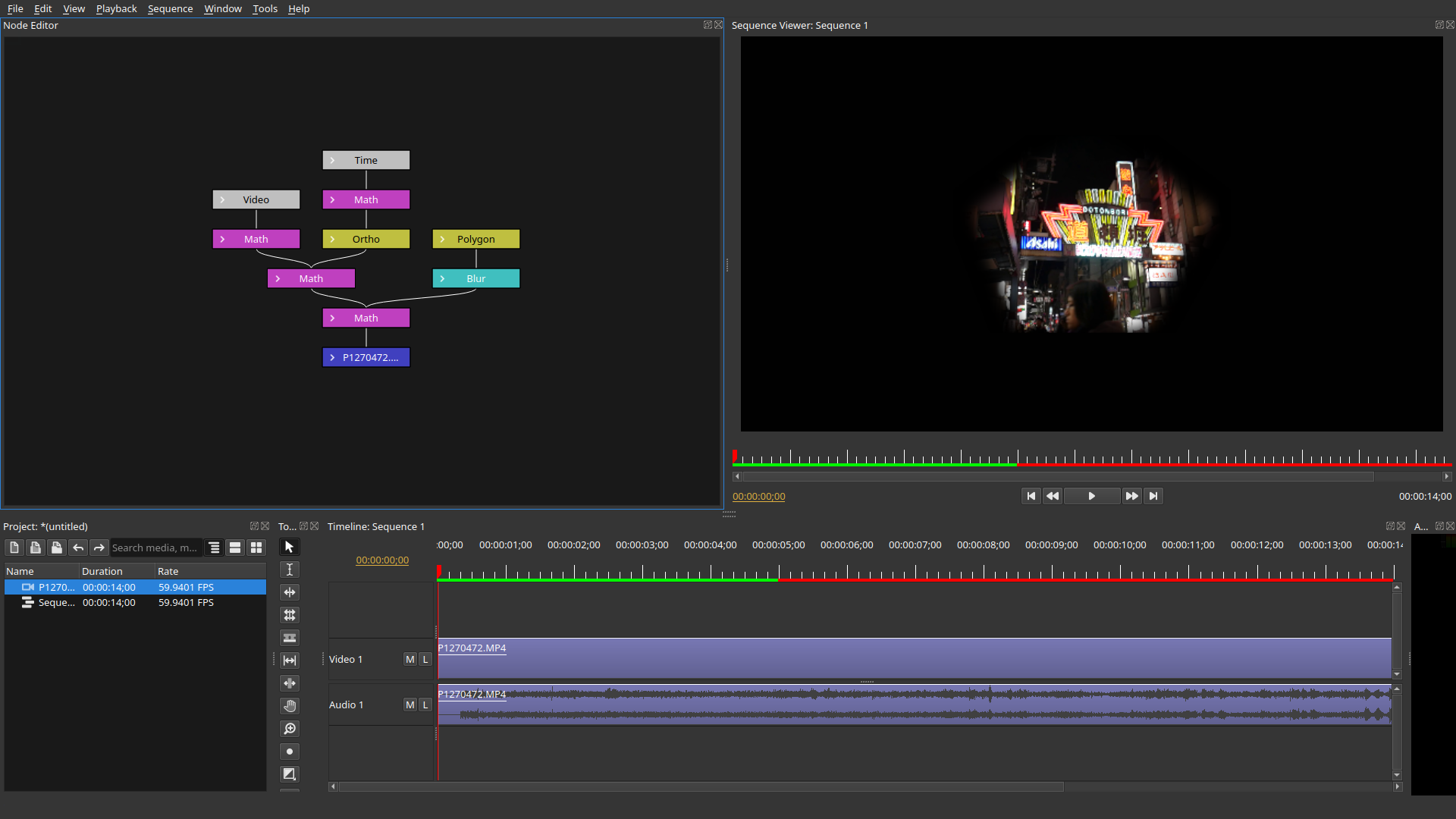
NOTE: Oak Video Editor is alpha software and is considered highly unstable. While we highly appreciate users testing and providing usage information, please use at your own risk.
Binaries
The binary can be downloaded here:
Building from Source
See docs/build.md for build instructions on Windows (MSYS2), Linux (Debian/Ubuntu, Fedora, Arch Linux), and macOS.
Documentation
- Project Storage Architecture (中文) — database write-through persistence, node-granular journal, persistent undo
- Build guide · 工程文件格式
Roadmap
| Version | Theme | Core Deliverables | Boundary Notes |
|---|---|---|---|
| 0.3 | Plugin Architecture Milestone | Production-ready OpenFX host support | Not about quantity of plugins, but "any OFX plugin loads without crashing" |
| 0.4 | Color, Audio & Performance | .cube/.3dl support, scopes (waveform/vectorscope/histogram), three-way color wheels, waveform auto-sync, BWF timecode sync, audio meters (LUFS/VU), proxy media workflow, hardware-accelerated export (NVENC/VideoToolbox), batch render queue |
Combines the previous 0.4-0.6 scope into one usability milestone: color workflow, audio sync, and 4K/8K performance |
| 0.5 | Animation, Tracking & Collaboration | Bézier keyframe curve editor, basic point tracking, image stabilizer, full multicam angle switching, OpenTimelineIO, EDL/XML import/export | Combines the previous 0.7-0.8 scope into one timeline/interchange milestone |
| 0.6 | Stability Milestone | Project file format freeze (backward compatibility promise), crash recovery, autosave, memory optimization | "Feature freeze" testing period before 1.0 |
| 1.0 | Production Ready | Complete documentation, installers, known issues list, community support channels | Declared "ready for serious projects" |