 Mike-Solar
48e99e56b7
Mike-Solar
48e99e56b7
docs/zh/plans/render-pipeline-threads.md M2: the graph's textures stay
on the GPU from evaluation through presentation, and presentation runs
on the UI's own wgpu device.

- wgpu 25 -> 29 (naga 29) across the engine, unifying it with
  gpui_wgpu so engine textures are directly sampleable by the presenter
  (a single wgpu remains in the lockfile).
- GpuContext::adopt/install_shared: the app registers the window's
  device at startup and the render thread renders on it;
  texture_handle hands the raw Arc<wgpu::Texture> to
  SurfaceSource::Texture - zero-copy present on Linux/FreeBSD. The
  shared slot replaces an engine context that has not touched the GPU
  yet (startup-order guard) and refuses once it has.
- Texture::Gpu shares a GpuLease so clones release the registry token
  exactly once; the compositor, transitions and adjustment sweeps keep
  GPU textures end to end (no per-clip readbacks; GPU clears for
  black/generated frames).
- Color management stays on the GPU: the output node + display ICC
  chain is baked into a 65^3 3D LUT with the exact CPU reference and
  applied by the present WGSL pass (manual trilinear);
  ColorTransformJob bakes its OCIO processor the same way. Neither
  path skips color management.
- The explicit readback boundaries accept GPU textures: export
  encoder, CLI, worker shm, disk cache; CPU OpenFX already read back.
- M5 dependency: the YUV->RGB GPU pass (BT.601/709/2020 x
  limited/full) matches colormath::yuv444p16_to_rgb_f32.
- Acceptance: gpu_transfer_counters; single-clip and layered
  (multi-track + transition + adjustment) playback tests assert zero
  GPU->CPU readbacks, and the app test asserts adopted-device present
  is zero-copy. GPU tests hard-fail when OAK_REQUIRE_GPU is set (CI
  lavapipe) instead of skipping silently.


Oak Video Editor 
Oak Video Editor is a free non-linear video editor for Windows, macOS, and Linux.
This project is a community-maintained fork of Olive Video Editor.
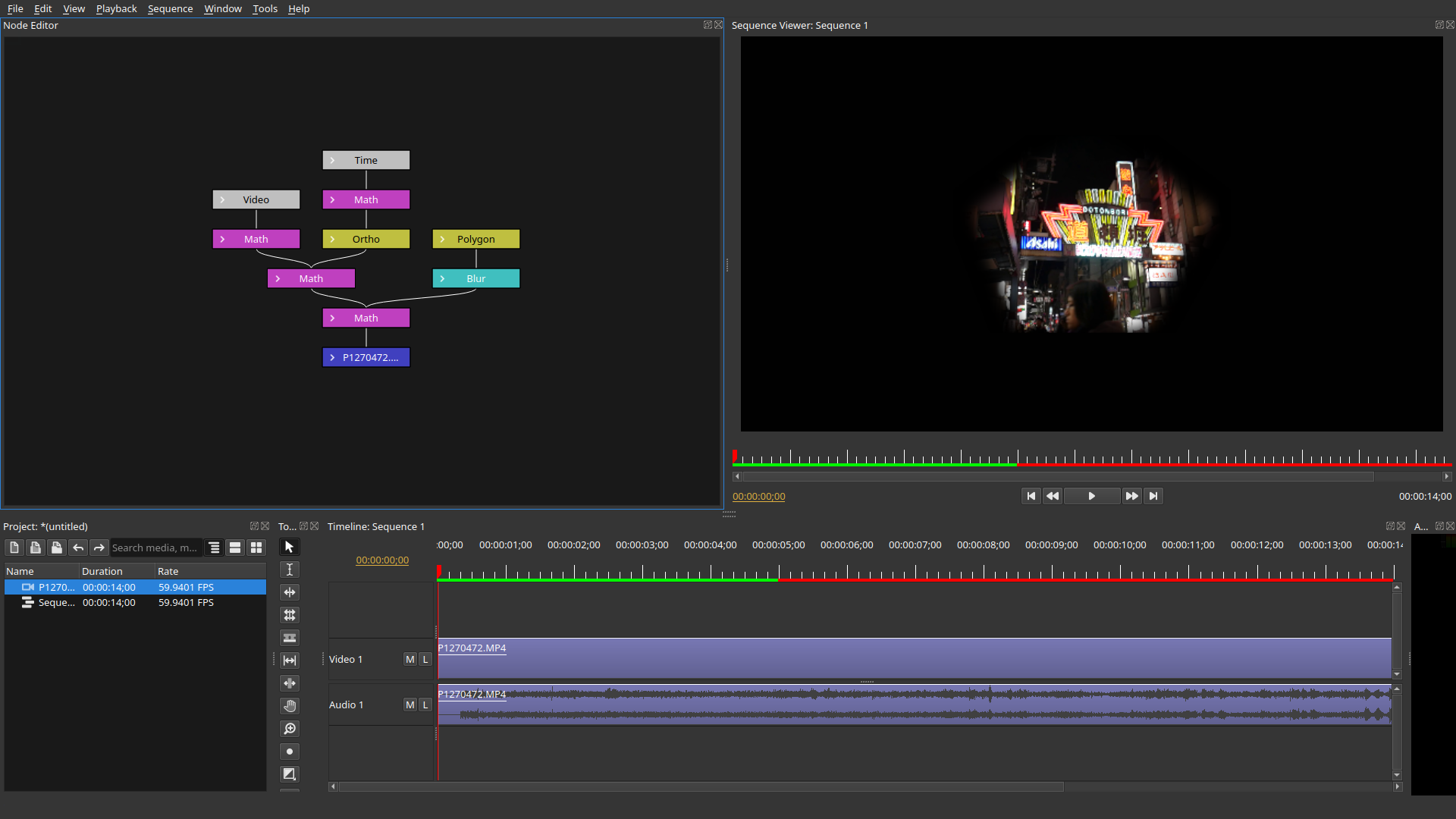
NOTE: Oak Video Editor is alpha software and is considered highly unstable. While we highly appreciate users testing and providing usage information, please use at your own risk.
Binaries
The binary can be downloaded here:
Building from Source
See docs/build.md for build instructions on Windows (MSYS2), Linux (Debian/Ubuntu, Fedora, Arch Linux), and macOS.
Documentation
- Project Storage Architecture (中文) — database write-through persistence, node-granular journal, persistent undo
- Build guide · 工程文件格式
Roadmap
| Version | Theme | Core Deliverables | Boundary Notes |
|---|---|---|---|
| 0.3 | Plugin Architecture Milestone | Production-ready OpenFX host support | Not about quantity of plugins, but "any OFX plugin loads without crashing" |
| 0.4 | Color, Audio & Performance | .cube/.3dl support, scopes (waveform/vectorscope/histogram), three-way color wheels, waveform auto-sync, BWF timecode sync, audio meters (LUFS/VU), proxy media workflow, hardware-accelerated export (NVENC/VideoToolbox), batch render queue |
Combines the previous 0.4-0.6 scope into one usability milestone: color workflow, audio sync, and 4K/8K performance |
| 0.5 | Animation, Tracking & Collaboration | Bézier keyframe curve editor, basic point tracking, image stabilizer, full multicam angle switching, OpenTimelineIO, EDL/XML import/export | Combines the previous 0.7-0.8 scope into one timeline/interchange milestone |
| 0.6 | Stability Milestone | Project file format freeze (backward compatibility promise), crash recovery, autosave, memory optimization | "Feature freeze" testing period before 1.0 |
| 1.0 | Production Ready | Complete documentation, installers, known issues list, community support channels | Declared "ready for serious projects" |